
At a Glance
- The humidity problem, explained ✓
- Material science, in depth ✓
- Step-by-step cleaning ritual ✓
- Monsoon-proof storage ✓
- Discreet storage for real Indian homes ✓
- FAQs ✓
Cleaning a personal wellness device deserves the same unremarkable routine as cleaning a menstrual cup or a pair of contact lenses. It is not a source of embarrassment. It is simply maintenance, and skipping it carries real clinical consequences: an improperly cleaned or stored toy is a genuine vector for urinary tract infections and bacterial vaginosis, not merely an aesthetic concern.
Most cleaning guides in this category were written for a different climate entirely. They assume a dry environment, a Western-style ventilated bathroom, and storage conditions that simply do not describe most Indian homes for a large part of the year. This guide was built for India specifically: for the humidity, for the joint-family bedroom, for the monsoon months that change the entire calculation.
The Indian Climate Factor: How Monsoon Humidity Breeds Bacteria
This is the single biggest gap in existing guidance, and the one most worth understanding properly before anything else.
Why 80 Percent Relative Humidity Changes Everything
Bacterial and fungal colonies need three things to establish themselves: moisture, warmth, and organic residue such as lubricant or bodily fluid. India’s monsoon belt and coastal cities such as Mumbai, Chennai, Kolkata, and Kochi sit at or near 80 percent relative humidity for weeks at a stretch during the monsoon months. That is precisely the combination these organisms need, sustained for far longer than a typical guide written for a temperate, dry climate ever anticipates. “Just air dry and store” is reasonable advice in a low-humidity country. It falls meaningfully short here.
The Invisible Damp Trap
A toy can look dry to the eye while remaining damp in the seams, around buttons, or at the join between base and handle, exactly the spots a quick wipe rarely reaches. Left this way, mold on silicone tends to appear as small, dark, or faintly pink spots settling into these grooves over time, a sign worth checking for specifically rather than assuming a surface wipe has covered it.
Monsoon-Specific Danger Windows
Between June and September, allow noticeably longer drying time before storing anything, and favour an air-conditioned or dehumidified room over a bathroom shelf or an almirah set against an exterior, rain-facing wall. The difference in ambient humidity between these two locations, during the monsoon specifically, is larger than it may seem.
Material Science: Porous Versus Non-Porous, Explained Properly
Nearly every existing guide repeats the same shorthand, silicone good, jelly bad, without ever explaining why. The distinction matters enough to deserve a genuine explanation.
Non-Porous, Body-Safe Materials
Medical-grade, platinum-cured silicone is non-porous at a molecular level, meaning nothing settles into its surface structure the way it does with lesser materials. Non-motorised silicone can be safely boiled for sterilisation, and it remains compatible only with water-based lubricant, never silicone-based, which causes surface breakdown on contact.
Borosilicate glass and surgical-grade stainless steel are similarly non-porous and among the easiest materials to fully sterilise, both tolerating boiling without concern.
ABS plastic, common in motorised housings, is also non-porous, though it should be wiped clean rather than submerged unless the product carries a specific waterproof rating.
Porous, Higher-Risk Materials
Jelly rubber and cheap TPE tell a different story at the microscopic level. Their surface contains tiny fissures invisible to the naked eye, and these fissures trap bacteria and lubricant residue in a way no amount of washing at home can fully clear. Many cheaper jelly products also contain phthalates, plasticisers linked to skin irritation and broader health concerns. These materials cannot be sterilised at home, full stop, regardless of how thoroughly they appear to have been cleaned.
Watch for a few tactile warning signs directly: a tacky surface, a slightly “weeping” texture, or a persistent odour that survives repeated washing. Any of these signals a material past the point of safe use.
The Boiling Rule, Clarified
Boiling is safe only for products that are entirely silicone, glass, or steel, with no motor, battery, or electronic component whatsoever. Boiling a motorised device destroys it outright. Waterproof ratings matter here too: a genuine IPX7 rating tolerates full submersion for a defined period, while “splash-proof” marketing language, often used loosely, means considerably less protection than it implies.
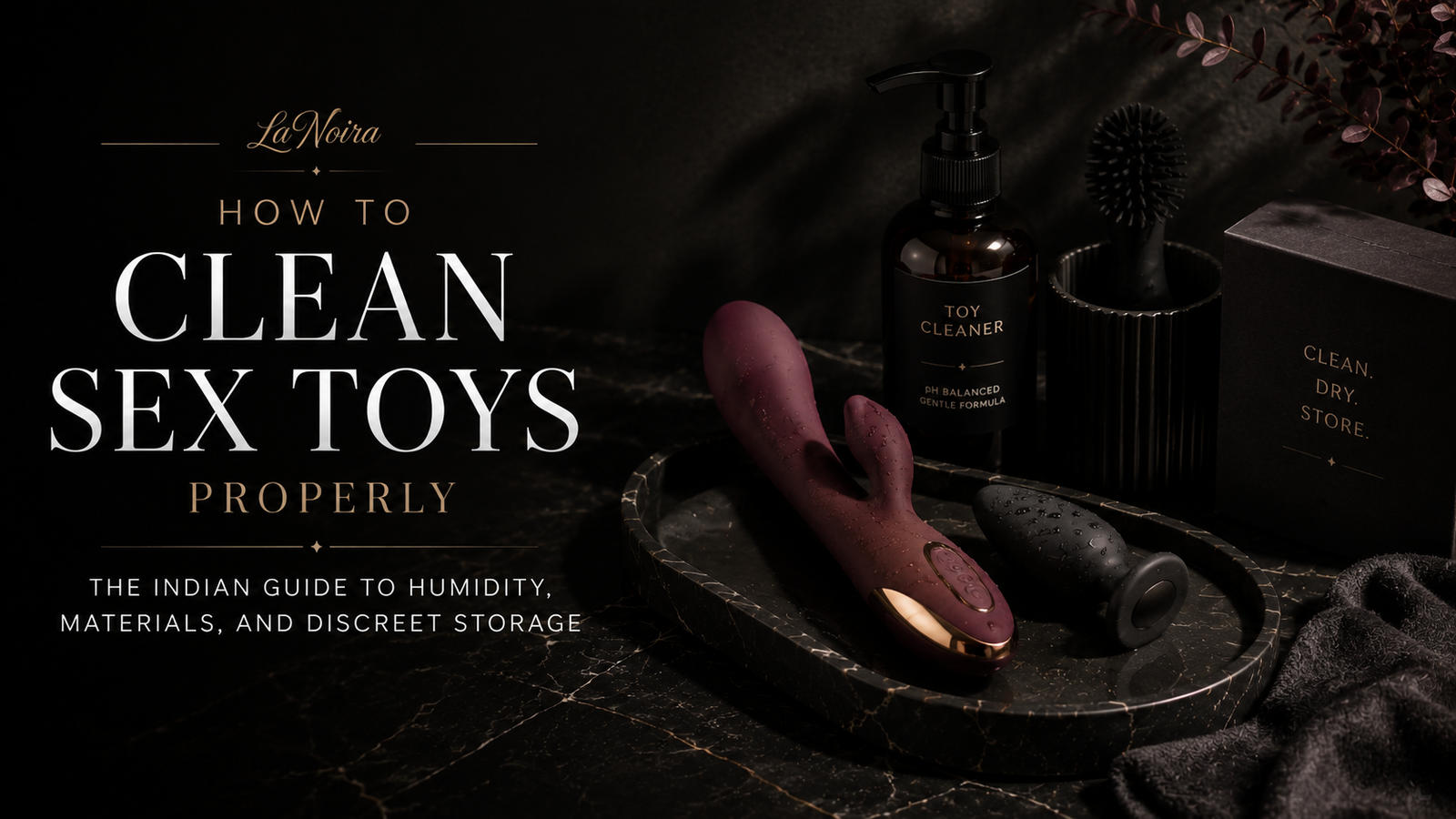
Step-by-Step Toy Cleaning Ritual
A consistent routine matters more than an elaborate one. The steps below apply after nearly every use, regardless of material.
Waterproof Versus Non-Waterproof: Know Before You Wash
Check the specific rating before cleaning. A fully submersible, IPX7-rated device can be rinsed directly under a tap. A non-waterproof or splash-resistant device requires a damp cloth instead, never full immersion.
The Correct Wash
- Rinse under warm, never hot, running water immediately after use.
- Use a pH-balanced, unscented, body-safe cleanser, never a fragranced hand soap, dish soap, or harsh alcohol-based spray.
- Work the cleanser into every seam, button, and the base-to-handle join specifically.
- Rinse thoroughly until no residue remains at all.
- Pat dry, then allow complete air-drying before storage.
Why “Convenient” Products Can Actually Harm Your Toy and Your Body
Harsh soaps, scented washes, and generic household cleaners can leave an invisible microfilm on silicone that alters the surface’s natural pH. That altered surface can, on next use, disrupt the body’s own pH balance in ways that raise irritation risk, a genuinely clinical concern rarely raised anywhere else in this category. Alcohol and bleach cause a related but separate problem: repeated exposure degrades silicone integrity over time, creating microscopic abrasions where bacteria can then settle.
The Body-Safe Care Connection
Pairing a premium silicone device with a clean-ingredient, water-based formula protects two things simultaneously: the body, through the absence of pH disruption or irritation, and the material itself, through the absence of the micro-abrasion that silicone-based or oil-based formulas can cause over time. The Isabel Fay Natural Water-Based Personal Lubricant was built around exactly this thinking, treating a clean formula and clean hardware as one connected system rather than two separate purchases. Our full comparison of water-based and silicone-based formulas covers the underlying reasoning in considerably more depth.
The No-Shed Drying and Discreet Storage Blueprint
Drying and storage deserve as much attention as the wash itself, and this is where most existing advice stops short entirely.
The Drying Mistake Almost Everyone Makes
Paper towels and fluffy cotton towels shed lint and microfibres that embed themselves into silicone’s slightly textured surface, trapping moisture and, eventually, bacteria along with it. A lint-free cloth or simple air-drying on a small rack avoids this problem entirely.
Building a Monsoon-Proof Storage System
A breathable fabric pouch outperforms a plastic ziplock bag by a wide margin, since plastic traps humidity against the surface rather than letting it dissipate, encouraging exactly the fungal growth this guide has been warning against. A small silica gel sachet inside the storage box or drawer, replaced every few months, adds further protection. Keep storage away from bathroom walls, exterior rain-facing walls, and direct sunlight, since ultraviolet exposure degrades silicone over time regardless of humidity. Store each item separately as well; different materials can react against one another during prolonged humid contact.
The Discretion Problem Nobody Else Solves
Real Indian households complicate storage in ways generic guides never account for: joint families, in-laws staying over, a shared bedroom, house help who organise and clean drawers as part of their routine, or hostel and PG living with minimal private space.
A handful of practical solutions handle this without drawing attention. A small lockable or zip-closure pouch, placed inside a larger, entirely unremarkable container such as a stationery box or a suitcase liner pocket, draws no notice whatsoever. Choosing a location that house help rarely accesses, such as a high shelf, a personal handbag compartment, or a small lockbox reserved for personal documents, solves the same problem from a different angle. LaNoira’s own delivery packaging and product pouches are designed with exactly this in mind: unbranded, quiet, and easy to tuck away without a second thought. Our dedicated discretion guide covers the delivery side of this in complete detail.
Quick Reference: Signs a Toy Needs Replacing
Cracks, a tacky surface, a persistent odour that survives washing, a weak or inconsistent motor, or unreliable charging are all signals worth acting on rather than working around.
A Final Word
Proper cleaning and climate-aware storage are not extra steps layered onto ownership. It is basic risk prevention, and it is also what extends the working life of a genuine investment-grade device. LaNoira’s curation, from material selection to packaging design, was built around Indian conditions specifically, humidity, discretion, and body safety together, rather than adapted from a script written for a different climate entirely.
For those building a complete, body-safe routine, our water-based lubricant collection pairs naturally with the cleaning principles covered here. And for a broader look at buying and using these products safely in India, our complete buying guide and couples-focused beginner’s guide round out the picture.
Note: This guide reflects general wellness information and does not replace medical advice. For persistent irritation, infection symptoms, or specific health concerns, please consult a gynaecologist or qualified healthcare provider.
Frequently Asked Questions.
Only if the toy is entirely silicone, glass, or steel — with no motor, battery, or electronic component of any kind. These non-porous, boilable materials can safely withstand three to five minutes in simmering water. Boiling a motorised device will destroy it — the heat penetrates the casing and damages both the motor and the battery irreversibly. For any device with a charge port, warm water and a body-safe cleanser is the correct method.
Three adjustments matter in India’s humid season. First, favour an air-conditioned or dehumidified room over any bathroom shelf — the heat-humidity cycle in bathrooms accelerates both material degradation and microbial growth. Second, use a breathable fabric pouch rather than a sealed plastic bag, which traps moisture against the surface. Third, place a silica gel sachet inside the storage pouch and replace it every few months once it has absorbed its capacity.
Sharing carries genuine hygiene considerations regardless of material — even non-porous surfaces can transfer bacteria and pathogens between uses. A barrier method such as a condom, changed between partners, alongside thorough cleaning before and after each use, reduces risk considerably. For toys shared across different sessions rather than simultaneously, a full clean with a body-safe cleanser between uses remains non-negotiable.
Before its first use — regardless of how it arrived packaged — and after every subsequent use, without exception. Factory handling, transit, and storage introduce contaminants that are invisible but present. The habit of cleaning before and after, rather than only after, is the one worth building from the outset.
A pH-balanced, unscented, body-safe cleanser formulated specifically for this purpose. The pH balance matters because residue from the cleanser itself comes into contact with the body. Harsh soaps and dish soap strip protective coatings and leave chemical residue. Alcohol-based sprays dry out and degrade silicone over repeated use. When a purpose-formulated cleanser is unavailable, a tiny amount of mild unscented soap followed by a thorough rinse is a reasonable temporary substitute — not a permanent method.
Three signs are worth knowing. Small dark or pink-tinted spots settling into seams, grooves, or textured surfaces indicate mould or bacterial colonies that cleaning alone will not resolve. A persistent odour despite washing suggests microbial activity embedded below the surface — a sign the material has been compromised. A tacky or slightly sticky surface that was not there originally points to material degradation, often accelerated by heat and moisture. Any one of these warrants retiring the toy rather than continuing use.
Content is informational and intended for adult readers. Care instructions may vary by product — always refer to the manufacturer’s guidance included with your instrument. For product-specific questions, contact our support team.